
The Truth About Timeline Delays
Supplement manufacturing delays are common. But most of them are predictable — and most of them could be communicated early. Here’s what’s really happening.

What Your Contract Manufacturer Isn’t Telling You About Timelines
The Email No One Wants to Send (And Why So Few Manufacturers Do)
It is three days before your launch. Your ads are scheduled. Your email sequence is queued. Your influencer has a post going out Friday morning. And you have not heard from your manufacturer in eleven days.
You send a check-in email — friendly, professional, just asking for an update on shipping. An hour passes. Then four. You send another. Then you call. You reach a general number, leave a voicemail, get transferred to someone who checks a system and tells you the order is “in production” — the same status it showed last week. No one can tell you when it ships. No one can tell you what changed. And no one, at any point, thought to call you first.
This is not a rare situation. It happens to founder-led supplement brands constantly, and the frustration isn’t just about the delay — it’s about the silence. A delay you know about is a problem you can manage. A delay you discover three days before launch is a crisis. The difference between those two outcomes is almost never about the manufacturing. It’s about who picks up the phone, and when.
The Real Reasons Supplement Orders Are Late
Delays in supplement manufacturing are not random. They have specific, predictable causes — and most of them are knowable well before they become your problem. Here’s what’s actually happening when your order runs long.
Raw Material Availability
Ingredient supply chains are not stable. Commodity ingredients shift with crop yields, import regulations, and supplier production schedules. A manufacturer who gives you a timeline in January may not account for the fact that a key ingredient is backordered in February. The delay was visible to them before production was scheduled — but disclosing it would require reopening the timeline conversation, and most operations prefer to stay quiet and hope the material arrives in time.
Production Scheduling Conflicts
Your order sits in a queue. The manufacturers who take the most volume have the longest queues, and your 500-unit run does not move to the front because your launch date changed. When a larger order runs long — a production issue, an ingredient switch, an unexpected reorder — every job behind it shifts. No one calls to tell you this has happened, because the person managing the queue isn’t the person communicating with clients.
QC Holds
After production, every batch goes through quality control before it ships. Certificate of Analysis testing takes time, and if a test result comes back out of spec — even on a minor parameter — the hold extends while the issue is investigated or the batch is rerun. This is the right process. The problem is that many manufacturers don’t proactively communicate that a QC hold is in progress, which means you’re waiting on a shipment with no idea it’s sitting in testing limbo.
Label Receipt Delays
This one is often the brand’s responsibility — but a good manufacturer tells you about the dependency upfront and follows up when the deadline approaches. Many don’t. If your label art arrives late to the printer, the printer runs late, and the labels arrive after the production window has passed, the order slips. That conversation should happen two weeks before the label deadline, not after it’s already missed.
Ingredient Substitution Without Notification
This is the most operationally serious cause of delay, and the least discussed. When a raw material becomes unavailable, some manufacturers substitute an alternative and continue production without informing the client. If the substituted ingredient fails your internal review — or if you find out after the product is already labeled — the remediation process is expensive and time-consuming. The delay compounds because a conversation that could have happened in day three is now happening in week eight.
Why Manufacturers Don’t Tell You When Something Goes Wrong
Understanding why communication breaks down isn’t about excusing it — it’s about knowing what you’re dealing with when you evaluate a manufacturer.
Most contract manufacturers are volume-throughput businesses. Revenue comes from running production at capacity. The business model rewards filling slots, not managing client relationships. That structural reality shapes everything downstream: how production teams are organized, who has authority to communicate a problem externally, and whether there’s anyone in the operation whose job it is to own your account.
At a large manufacturer, the person who sold you the contract is rarely the person who manages your production. The production floor runs on an internal system. A problem on your batch is logged in that system. Whether that problem gets communicated to you depends on whether someone whose job includes client communication notices the flag, decides it’s worth raising, and has the authority to give you a revised timeline — rather than hoping the issue resolves before you notice.
Most of the time, that person doesn’t exist in your account. The result is silence by default.
Why large manufacturers are structurally unable to fix this
The economics of high-volume contract manufacturing don’t support dedicated account management at the per-client level. When a facility is running dozens of SKUs for dozens of brands simultaneously, proactive communication about individual order status requires either a staffing investment the margin doesn’t justify, or a software system sophisticated enough to flag client-affecting issues automatically and route them to someone with client-communication authority.
Most large manufacturers have neither. They have a sales team, a production team, and a shipping team — and the communication between those teams and the client is largely reactive. You call when you’re worried. They respond when they have something definitive to say. The gap between those two moments is where your launch window disappears.
This isn’t fixable through better intentions. It’s a structural problem, and the only way around it is to work with a manufacturer where the person who made the commitment to your timeline is also the person accountable for keeping it.
How Realistic Timeline Commitments Are Actually Made — and How to Tell If Yours Isn’t
An honest timeline is built from the actual sequence of dependencies, not from what you want to hear. Here’s the difference.
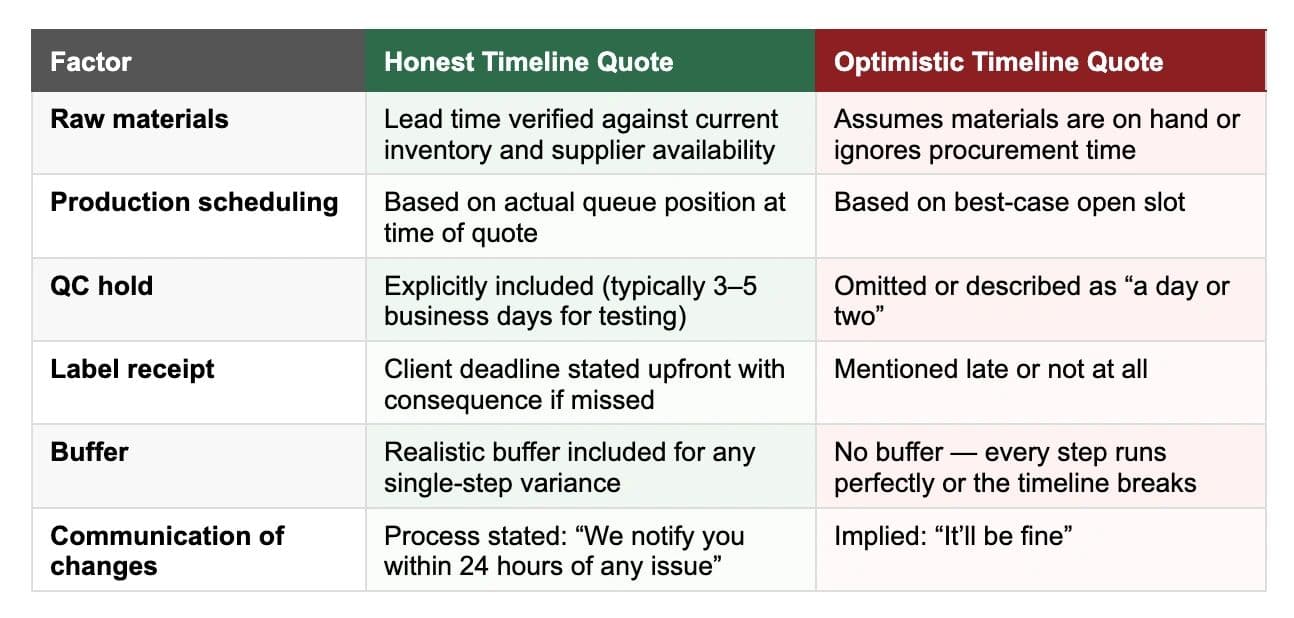
The optimistic timeline isn’t always dishonest in intent. It’s often what the manufacturer genuinely believes is possible in the best case. The problem is that best-case manufacturing is not standard manufacturing, and a timeline built on best-case assumptions gives you no warning when one step slips.
When you receive a timeline from a manufacturer, ask one question: what is the latest this could ship if one thing goes wrong? If they can’t answer that specifically, the timeline you’ve been given has no slack built in — and you’ll find out what that means when it matters most.
What Proactive Communication Actually Looks Like in Manufacturing
Proactive communication in supplement manufacturing has a specific, achievable standard. It isn’t complicated. It requires someone accountable and a commitment to act on that accountability.
The standard looks like this: within 24 hours of any development that affects your timeline — a raw material delay, a QC hold, a scheduling conflict — your point of contact calls or emails with three things: what happened, what the revised completion estimate is, and what, if anything, is required from you.
That’s it. No long explanations. No defensive hedging. A factual update with a revised date.
What it requires on the manufacturer’s side: one person who knows your order, watches its status, and has the authority to communicate a change without escalating through three layers of internal review first. At a large operation, that person is hard to identify and harder to reach. At a smaller one, it’s the person who took your first call.
The absence of proactive communication isn’t a communication style preference — it’s a signal about the accountability structure of the operation you’re working with. If no one is accountable for your timeline, no one will call you when it changes.
What to Do If You’re Mid-Project and Behind Schedule Right Now
If you are currently in a delay and trying to get real information, here is a step-by-step approach. The goal is clarity on actual status — not reassurance.
Step 1: Request written confirmation of current production status.
Email, not phone. You want a paper trail. Use this language:
“Can you confirm in writing the current production status of my order, the next scheduled milestone, and the anticipated ship date? I need this by end of business today.”
Written requests are harder to deflect with vague verbal updates.
Step 2: Ask for the specific bottleneck by name.
If the response is “in production” or “in queue,” follow up immediately:
“What specifically is the current hold on my order — raw materials, production scheduling, QC, or something else? And when was this status last updated?”
Vague status language is a substitute for information. Specific questions make vague answers harder to sustain.
Step 3: Get the revised in-hands date in writing.
“Based on the current status, what is the latest date I can realistically expect product in hand? I need a specific date, not an estimate range.”
Once you have a written date, you have something to hold to and something to act on if it slips again.
Step 4: Identify what’s in your control.
If the delay involves your label — not yet delivered, print error, in revision — act on that immediately. If the delay involves raw materials, ask whether your formula permits a substitution you’d need to approve, and make that decision explicitly rather than letting the manufacturer make it for you silently.
Step 5: Decide whether the revised timeline works.
If the new date is workable, confirm it in writing and ask for a check-in midpoint. If it isn’t workable, you have two options: escalate within the manufacturer’s organization to find whether anything can be accelerated, or begin the conversation with a backup manufacturer immediately. Starting that conversation while your current order is still in production is uncomfortable but not disloyal — it’s responsible planning.
The Question to Ask Any New Manufacturer Before You Sign
Before you sign with any manufacturer — new or existing — ask them this directly:
“When something goes wrong mid-production, what is your process for notifying me, and who specifically makes that call?”
You are not asking whether things go wrong. Things go wrong in manufacturing. You are asking who owns the communication when they do.
If the answer is a specific person’s name and a specific commitment — “I call you within 24 hours, here’s my direct line” — you are working with a manufacturer who has thought about this and accepted the accountability. If the answer is a department, a process, a system, or a vague assurance that you’ll be kept informed, you are about to find out what silence sounds like at the worst possible moment.
At Catamount Labs, Tom Wright is the person who makes that call — before you have to ask. If you’re dealing with a manufacturer who’s gone quiet on your order, or evaluating one who won’t, the conversation starts at catamount-labs.com.
When something goes wrong mid-production, who specifically makes that call to you?